This is going to be a different post from my usual writing focused ones. Don’t be afraid. I’ll talk you through it. I just want to share some of my daily work life.
While I love writing, it is not what I do professionally. By trade, I am an engineer. More specifically, I am an aerospace engineering graduate who has spent most of his career doing project and mechanical engineering in the aerospace industry. For the last couple years, I’ve been a kind-of freelance engineer. I currently work under the name ‘Design with Valor’. You’ve probably noticed the similarity to the name of this blog. Yes, I found a semi-creative and cute way to throw my name into something. I’ll keep doing it until I get bored with it.
Anyways, on to the main topic.
As a mechanical engineer, designing stuff is one of my main jobs. From actual parts that get sold to molds that make those parts to assembly jigs that are used in piecing everything together, I’ve been involved in lots of different designs over the last 10+ years.
A couple of years ago, my sister approached me with an idea. She was asked by the city of San Diego to start tracking the number of cigarette butts she and her clean-up crew were collecting. I should mention, she started a non-profit many years ago dedicated to picking up trash on beaches and in local neighborhoods. It’s called Essence of Earth, and her name is Essence.
Yes, that’s where I got my blog and company name idea, from my sister (Essence) and her non-profit (Essence of Earth). She included her name in her organization first. No, I am not as creative as you may have originally thought. But I don’t mind saying I got the idea from her. She’s pretty cool.
Digression aside, the counting meant that she was going to start separating cigarette butts from the trash they collected during clean-ups. They already separated the trash by hand for recycling and such, but pulling out cigarette butts was painfully slow because of the size. To help with separation some people would carry dedicated buckets for the butts, but that just became a lot to carry.
Just imagine carrying 2 large buckets and a grabber claw. You’d need a third arm. That’s when she and one of the non-profit’s officers decided to approach me about designing a container that would hang onto the side of their 5-gallon buckets to carry cigarette butts.
It was a fairly straight-forward idea, they wanted a container that could clip/hang/attach to the side of the containers and carry the collected cigarette butts. They were fairly open to letting me design it with the understanding that this was going to be iterative and they would drive the changes in each iteration.
My first go at the design used a couple of plastic rings to hold a plastic bag in place. The larger ring had legs that hung onto the side of the bucket. I 3D printed the design on my home printer, glued in some reinforcements I had planned for, and brought it to a clean-up.
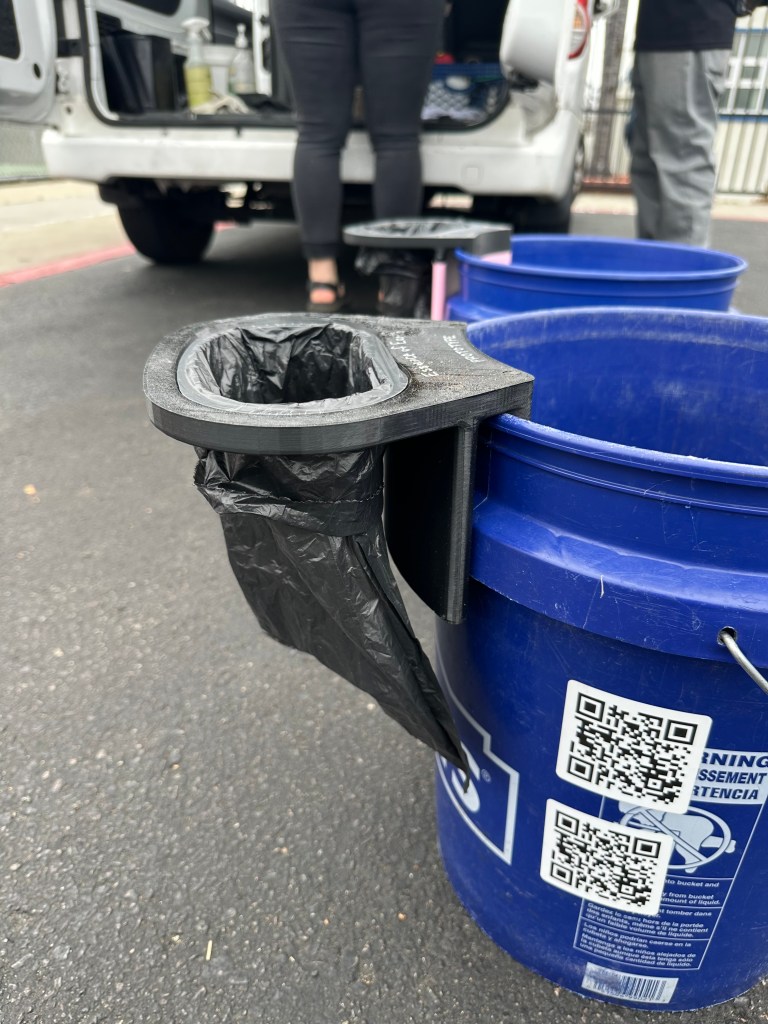
It was a good first attempt, but they let me know that it was a little more complicated than they had wanted. Lots of volunteers were going to use this. Also, they wanted to avoid carrying around extra plastic bags. All very valid opinions. Simplicity and less hassle are the hallmark of consumer-based designs.
The next attempt took the same footprint of the last design and removed the need for a separate bag. It was all one print. I also decided to be a little extra and include the non-profit’s name on the top.
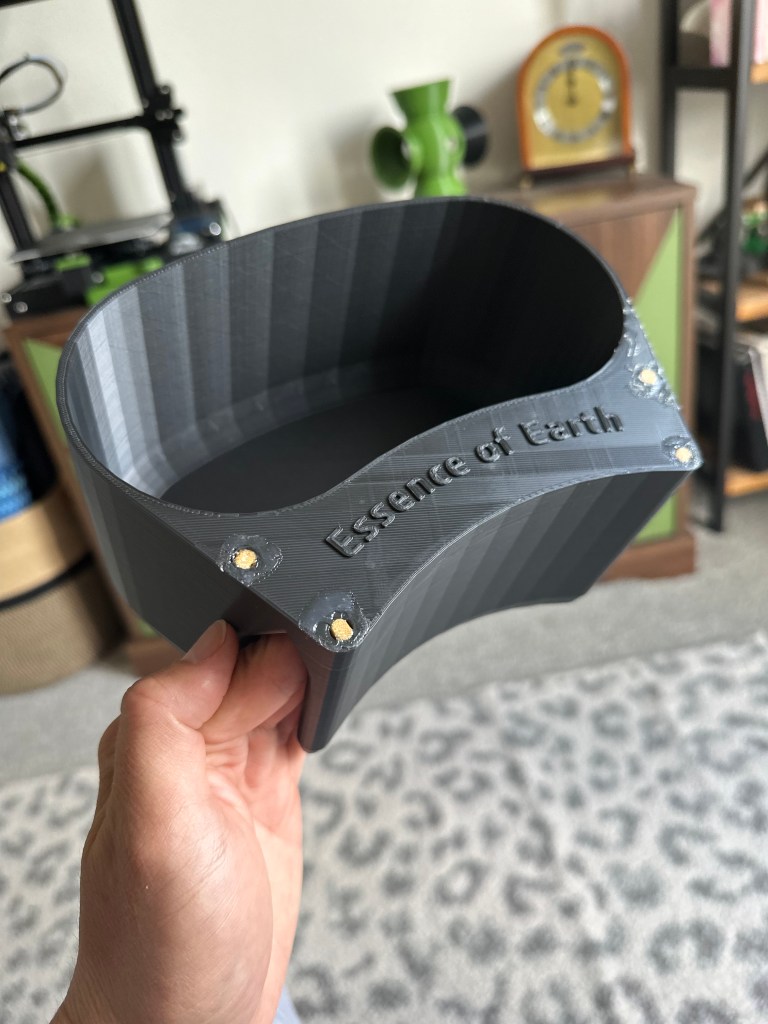
Unfortunately, I knew the issue with this design the moment I took it off the print bed. It was too heavy. I designed it with fairly thin walls, and the infill was set to 30%, but it was just too big. The whole thing was approximately 8 inches wide by 5 inches deep and almost 6 inches tall.
I still brought the second iteration to the next clean-up. It was so heavy that it tilted the buckets when you were carrying it. We all agreed that smaller would be better. They also informed me that the most dedicated cigarette butt collectors would gather around 100 cigarette butts during a clean-up and most volunteers got somewhere around 20-50. The current behemoth I created could probably hold over 500! Cigarette butts don’t take up that much space.
So, it was on to the next design.
The third design greatly shrunk the size, probably 1/4 the carrying capacity of the previous one. In the last 2 iterations, you could see the wood reinforcements and glue on the top of the container. That really bothered me to look at. So, I made the reinforcement a single sided entry from the bottom and closed it off on the top. Now they were hidden.
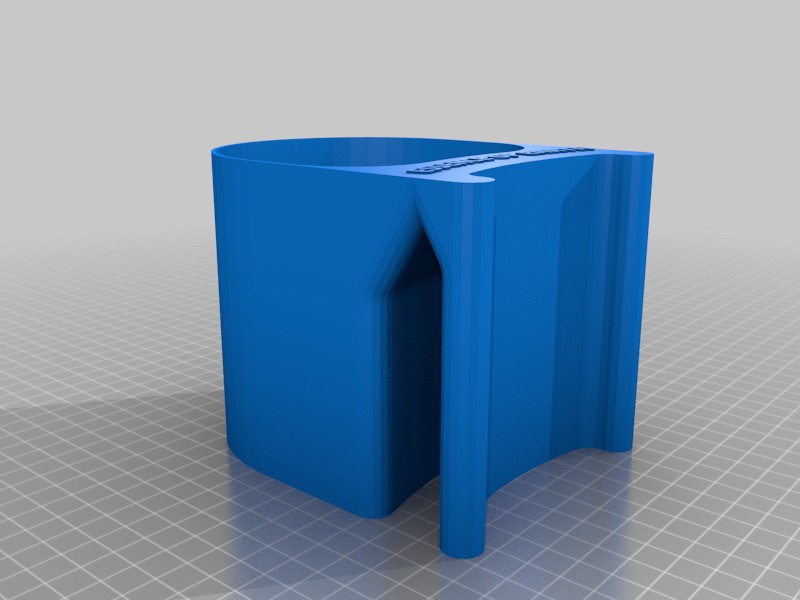
I didn’t get any real-life photos of this one, but they were very happy with it. It was light, a good size, and held on really well.
The next and final issue to come about was storage. I’d only printed 1 of each iteration, but now they had 3 containers. They began to realize that they were going to have an issue storing approximately 10 to 20 of these. I’d never even given that part of the design a single thought.
This was a bit more challenging.
The idea of stacking into each other like red Solo cups was my first thought, but I dismissed it pretty quickly. The reason being that the reinforcements I included created 4 very thick sections that would make the nesting into each other practically impossible.
So, what else could be the solution? I thought about adding some interlocking features so they would lock onto one another. But that didn’t really save space, just made it so they were all attached. Then I played around with the idea that the attaching arms could nest into each other like some trippy M.C. Escher tessellation. This had a similar issue as the other one. Very little space saved, just a way to connect them all. On top of that, both of those ideas were adding a little too much complexity for me and the users. Was I really going to give them a puzzle to handle?
That’s when I realized my first idea needed to be reevaluated. Were the reinforcements really too thick for stacking? I played around with drafting the walls (making them angled) and realized I could make it work, but the box became very triangular and really decreased the carrying capacity. So, it was possible, but not preferrable.
Finally, I asked myself, “Why did I have the reinforcements in the first place?” I hadn’t done any real-life testing to confirm my hypothesis that the print would be too weak to handle this. I think my time in the aerospace industry really taught me not to trust the strength of 3D printed parts. But the stakes are a lot higher when it comes to aircraft. This was a container that carried literal trash, it wasn’t going to carry a lot, and it could be easily repaired if it broke. Looking back, I should have rethought the reinforcements after I reduced the size.
Potentially, this part of the design was like your appendix. It’s there, but it doesn’t really do anything. So, I quickly modeled a version without the reinforcements. I gave the walls a small draft angle so that they would nest when stacked. I popped some drainage holes in the bottom. And lastly, I gave the non-reinforced leg a slightly wavy pattern.
Waviness actually makes walls more rigid. Look up crinkle crankle walls.
Anyways, I got thin walls and a new design that stacked like solo cups. But I had to test it first. It was time for another print.
The 4th iteration print came out just fine. It was the lightest yet and it felt sturdy enough. It didn’t feel like a Fabergé egg. I gave it a little shake, no damage. Then I put it on my own 5-gallon paint bucket and pulled out some weights. I ended up putting 8 pounds onto that little guy and it held up! There was no way it’d need to ever carry even half that weight. The factor of safety was definitely over 2.
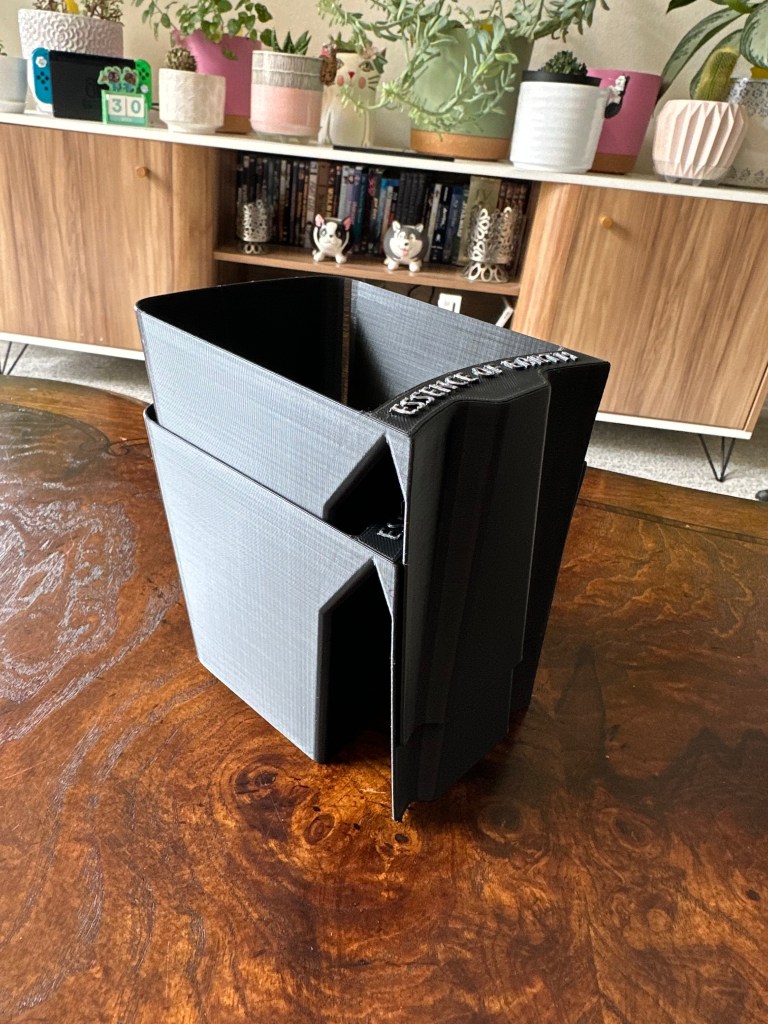
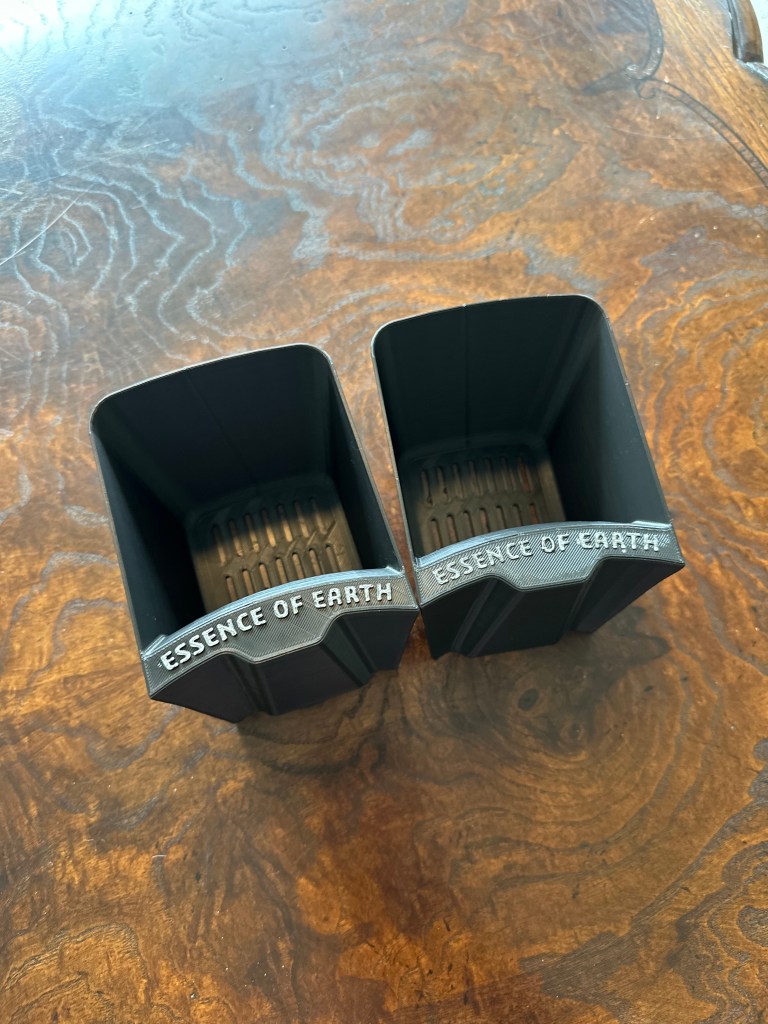
My sister and the team loved it. We’d found a way to get everything they wanted out of the design. It’s simple to make (no more gluing in reinforcements), lighter, easy to use, and easy to store. Could I make it better? Of course. But I do strongly believe in the saying, ‘Perfection is the enemy of progress.’ Sometimes you have to stop when something is good enough. And this was good enough.
I’ve also learned over the years that if your customer says they’re happy with something, then you really ought to stop. Unless you see something critically wrong, the work you put in to make further changes is almost never recognized as a good thing. Instead, everyone sees it as holding up production.
On a side note (kinda just bragging), this design is very easily converted into injection molding or even paper moulding. Not that my sister or her non-profit needs to think about that, but it was easy to incorporate.
Here’s my little lesson for any future engineers. When you are working with a customer, client, or team on a design then you’ve got to be open to making changes. If you start digging your heels in on something you think is ‘right’, you set yourself up as someone not easy to work with. This could mean you get left out of projects or promotions. In the freelance world, this means less return clients. Also, being unopen to change hinders creativity. This final product is pretty different from my original idea and was only possible because of the feedback I received.
This lesson applies to all aspects of life too. Being open to change is really what makes us grow as people. ‘The only thing constant in life is that nothing is constant.’ That’s something my dad used to say when I was young, and it has always stuck with me. Adaption is key to growth and success.
Anyways, I hope you enjoyed a peak into my daily work life. I’ve got some more short fiction stories brewing in my mind, but I figured this was a nice palate cleanser before I get back into it.
I do design things for myself. You can check out my Thingiverse profile where I share some of those designs with everyone.
A link to Valor’s Thingiverse page
My sister and her non-profit approved me posting the designs to my profile as well. So, you can check them out and spin them around on the site if you’re interested.
 blogwithvalor
Leave a comment